
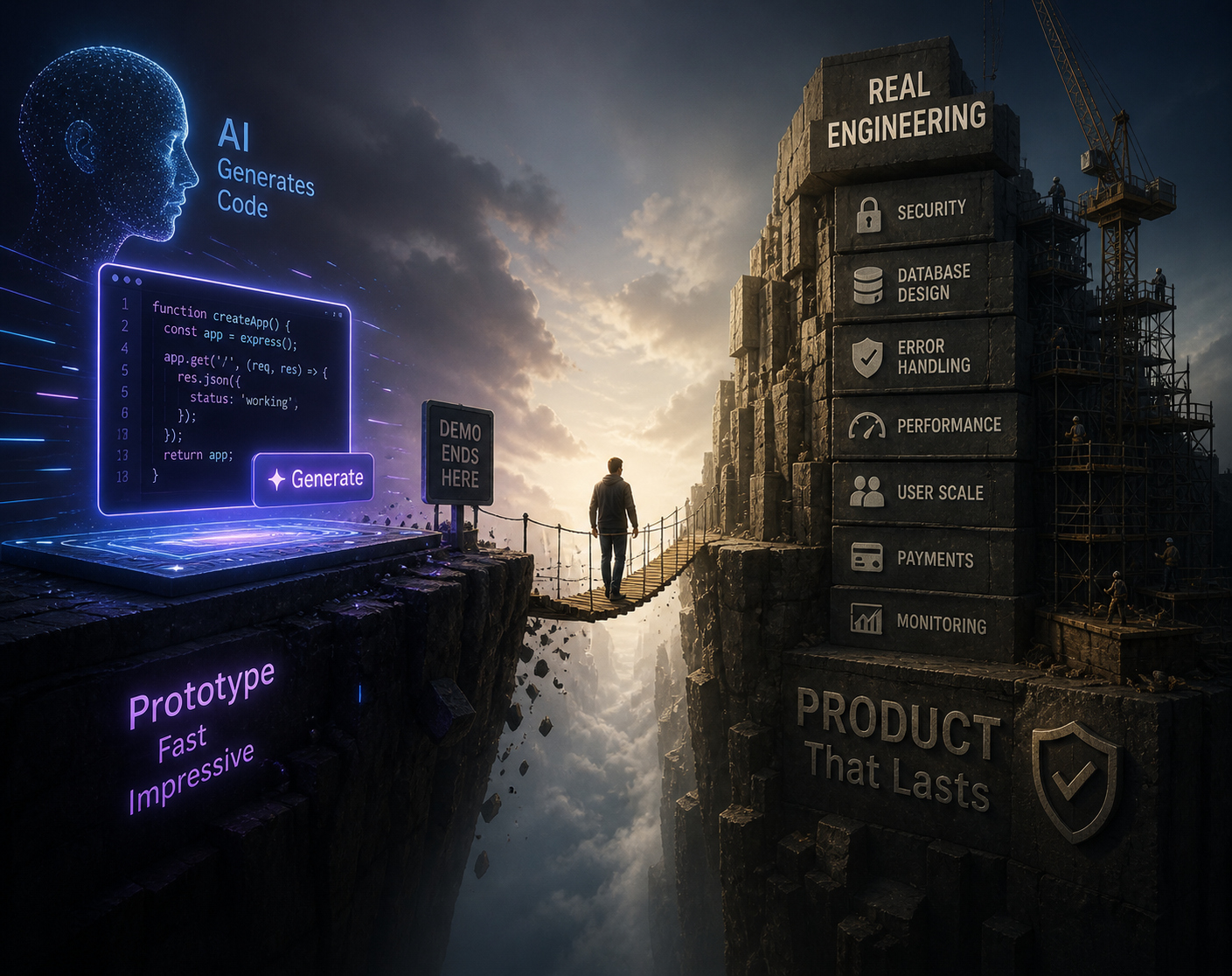
AI coding tools can scaffold a working prototype faster than any human team. That's genuinely useful - we use these tools ourselves every day. But there's a precise moment where every impressive demo ends, and it ends before the hard part starts.
It ends before the authentication system needs to handle edge cases gracefully. Before the database schema needs to perform under millions of rows. Before the payment integration needs to handle failures and refund flows. Before deployed code starts throwing errors that only appear under real traffic with real users.
The demo ends at the prototype. A product has to survive past it.
What AI-generated code needs that AI can't provide
AI code generation tools write code that works in the narrow context of the prompt. They don't write code that's secure, maintainable, or architecturally sound by default. That responsibility belongs to the engineer reading the output - and it always has.
In codebases where engineering oversight was limited - regardless of how they were built - certain patterns appear consistently. Database queries vulnerable to injection. API endpoints missing rate limiting and input validation. Business logic duplicated across files because no one was tracking what already existed. Database calls inside loops that work fine with a hundred records and fall apart with a hundred thousand.
None of this is a flaw in the tools. It's a flaw in using tools without the judgment to evaluate their output.
What actually takes time in software development
Writing code is not the slow part. It never was.
The slow part is understanding what to build precisely enough that the code is actually correct. Designing a data model that won't need restructuring when requirements change - and they always change. Anticipating edge cases that only appear when real users interact with a system in ways nobody predicted. Debugging a production issue that only reproduces under a specific combination of conditions no test caught.
AI tools accelerate the writing. They don't accelerate the thinking. The thinking is where the value is.
How we actually use AI tools
We use AI tools extensively - GitHub Copilot, Claude, and others are part of how we work every day. We use them for what they're genuinely good at: generating boilerplate that follows a pattern we've already defined, writing first drafts of documentation, suggesting implementations for well-defined isolated problems, speeding up the parts of development that are mechanical rather than intellectual.
What we don't do is hand them architectural decisions. We don't let them define the data model. We don't deploy their output without review. We don't use them as a substitute for understanding the system being built.
AI makes skilled engineers faster. It doesn't make the absence of skilled engineers safe.
The question was never whether AI changes software development. It does, meaningfully. The question is whether it eliminates the need for engineers who understand systems deeply, think carefully about architecture, and take responsibility for what runs in production. It doesn't. If anything, it raises the bar - because now the mechanical parts are faster, the differentiator is entirely the judgment that sits above them.

