
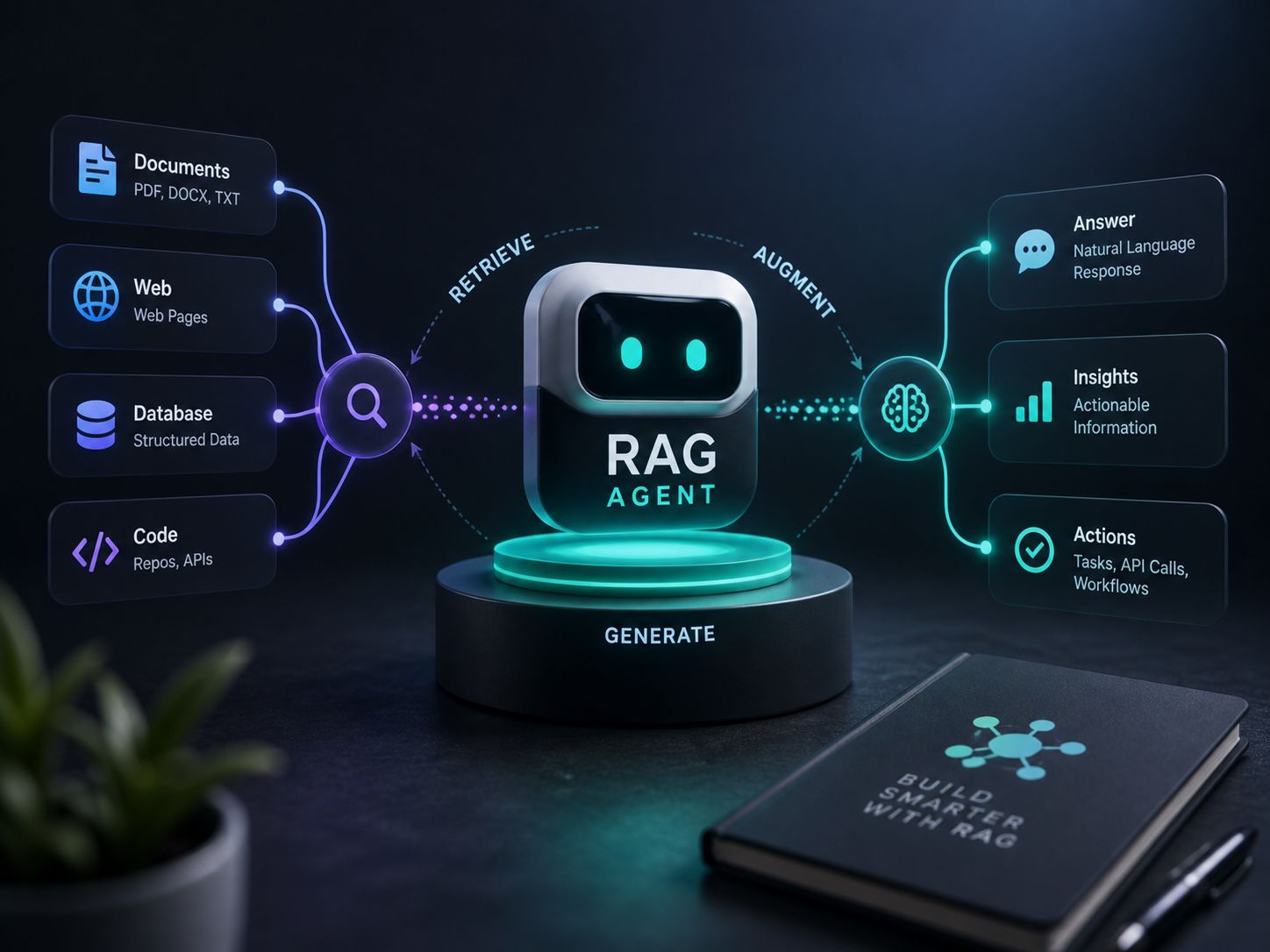
A standard AI language model knows a lot about the world in general but knows nothing specific about your business. It does not know your products, your policies, your contracts, your customers, or anything that has happened since it was trained. Ask it a question about your refund policy and it will either say it does not know or, worse, make something up that sounds plausible but is wrong. This is the fundamental limitation of using a general-purpose language model for business-specific questions. RAG - Retrieval-Augmented Generation - is the architecture that solves this problem.
The way RAG works is straightforward. When a user asks a question, the system does not go straight to the language model. First, it searches your documents - your knowledge base, your product documentation, your contracts, your support articles, whatever content is relevant - and finds the sections most likely to contain the answer. It then gives those sections to the language model as context, along with the user's question, and asks the model to answer based on that context. The model is not guessing or drawing on general knowledge. It is reading the specific content that was retrieved and synthesising an answer from it. The answer can be traced back to the source document.
We build RAG systems that work correctly in production, which is harder than it sounds. The quality of a RAG system depends on decisions made at every step - how documents are split before being stored, which embedding model converts them to a searchable format, how the search ranks and selects the most relevant content, how the retrieved content is presented to the language model, and how the model is instructed to use it. Getting any of these steps wrong produces answers that are inaccurate, incomplete, or confidently wrong. We have built enough RAG systems to know where the problems occur and how to avoid them.
What this means for your product:
- AI that answers questions using your actual documents and data - not general knowledge
- Answers that can be traced back to a source so users know where the information came from
- A system that stays accurate as your documents change - update the documents, the answers update
- No hallucination from general knowledge - the model answers from what it retrieves
Chips:
RAG · Vector Search · Embeddings · Semantic Retrieval · pgvector · Pinecone · LLM · Citations

